Carlsberg makes bio-based and fully recyclable bottles available to consumers in its largest ever trial
Comunicato Precedente

Comunicato Successivo


A significant milestone for the Fibre Bottle is its plant-based PEF polymer lining, which has been developed by Carlsberg's partner Avantium, a leading expert in renewable chemistry. PEF is made entirely from natural raw materials, is compatible with plastic recycling systems, and can degrade into nature should it end up outside national recycling systems. Beyond its sustainable packaging benefits, PEF functions as a highly effective barrier between the beer and the fibre outer shell, protecting the taste and fizziness of the beer better than conventional fossil-fuel-based PET plastic.
The outer shell of the bottle, produced by the packaging company Paboco, consists of sustainably-sourced wood fibre and is also bio-based. This shell has the added benefit of insulative properties which can help keep beer colder for longer, compared to cans or glass bottles.
Stephane Munch, VP Group Development at Carlsberg, says: "We are delighted to bring our new Fibre Bottle into the hands of consumers, allowing them to experience it for themselves. This pilot will serve a greater purpose in testing the production, performance and recycling of this product at scale."
"Identifying and producing PEF, as a competent functional barrier for beer, has been one of our greatest challenges - so getting good test results, collaborating with suppliers and seeing the bottles being filled on the line is a great achievement!"
The bottle is 100% bio-based apart from the cap, which is currently needed to ensure the quality of the product, and together the bottle and cap are fully recyclable. Going forward, Paboco, Carlsberg and partners in the wider Paper Bottle Community are exploring alternative fibre-based bottle caps, with a generic solution expected in 2023. Carlsberg will continue development, together with Avantium and Paboco, to arrive at a tailored 3.0 solution that is equally suitable for primary beer packaging, using this year's consumer feedback and Paboco's developments.
Advancements have not been limited to the bottle itself, as Carlsberg has also bottled a more sustainable brew for its 2022 consumer trials. In collaboration with barley malt supplier Soufflet, Carlsberg has brewed a beer with barley that has been cultivated using fully organic and regenerative agricultural practices. More specifically, cover crops have been grown in the organic barley fields to contribute some additional benefits of regenerative farming.
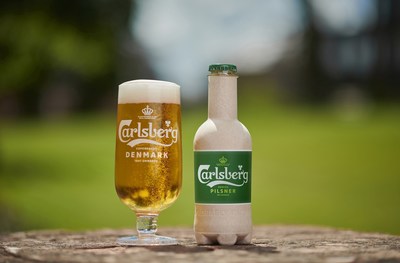
While consumers can still expect the same distinctive Carlsberg taste, the methods used to farm the barley are set to improve farmland biodiversity, enhance soil health, and increase natural carbon sequestration by the soil versus conventional farming methods.
Generation 2.0 of the Fibre Bottle already performs better than the single-use glass bottle in the product´s lifecycle assessment, and Carlsberg has even greater ambitions for the subsequent Generation 3.0 design. Carlsberg's vision, supported by current projections, is for the Fibre Bottle to achieve up to 80% less emissions than current single-use glass bottles.
Thus, for every single-use glass bottle created, five Fibre Bottles could be created using the same carbon footprint. Ultimately, Carlsberg is aiming for the Fibre Bottle to achieve the same low carbon footprint as the refillable glass bottle, which is currently the best- performing primary packaging when collected and reused in efficient systems. When the Fibre Bottle is commercialised at scale, it will expand Carlsberg consumers' choice and complement, rather than replace, existing packaging like glass bottles and cans.
Simon Boas Hoffmeyer, Group Sustainability Director at Carlsberg, adds: "The progress made with our new Fibre Bottle is testament to Carlsberg's pioneering spirit, with a focus on making better products in every sense of the word. We've been working hard on this project since 2015, and aim to continue to set the industry standard by further improving the bottle's environmental footprint and product performance. Collaboration is key and, together with our partners, we're excited to see how research and development into sustainable packaging solutions is now becoming the norm."
The trial precedes the global launch of Carlsberg's ambitious ESG programme, Together Towards Zero and Beyond, which will build on existing sustainability performance and momentum to take on new ambitions within sustainable agriculture and sustainable packaging, ultimately enabling Carlsberg to reduce its carbon impacts across the full value chain.
Photo - https://mma.prnewswire.com/media/1843958/Carlsberg.jpg

Ufficio Stampa
PR Newswire (Leggi tutti i comunicati)
209 - 215 Blackfriars Road
LONDON United Kingdom