Glucagon Receptor Structures Reveal G protein Specificity Mechanism
Comunicato Precedente

Comunicato Successivo
However, the molecular details that define how an individual GPCR recognizes different G protein subtypes remain elusive, thus limiting the understanding of mechanisms of GPCR signal transduction.
This study offers valuable insights into pleiotropic GPCR-G protein coupling and G protein specificity. The most exciting finding is that the sixth transmembrane helix (helix VI) of GCGR adopts a similar outward shift in the two G protein-bound GCGR structures, forming a common binding cavity to accommodate Gs and Gi. This common G protein binding pocket is consistent with the signaling pleiotropy of GCGR, and allows for maximal efficiency in activating various pathways.
Although GCGR couples to both G proteins through the common pocket, it does so with different interaction patterns, which account for G protein specificity. The measured interaction interface between GCGR and Gs is much larger than for Gi, resulting in higher binding affinity of Gs to the receptor. This offers a structural basis for the preferential coupling of GCGR to Gs.
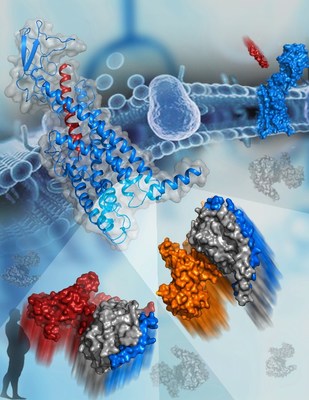
Based on the structures of GCGR-G protein complexes, the researchers performed extensive functional studies using techniques such as mutagenesis, G protein activation and cell signaling to investigate the roles of key residues in the receptor-G protein binding interface in Gs and Gi activation. The results show that conformational differences of intracellular loops and residue side chains in the receptor are sufficient to guide G protein selectivity.
These findings present new opportunities for drug discovery by designing biased ligands to selectively block one specific signaling pathway, thus resulting in reduced side effects.
Photo - https://mma.prnewswire.com/media/1134716/cryo_EM_structures_GCGR.jpg

Ufficio Stampa
PR Newswire (Leggi tutti i comunicati)
209 - 215 Blackfriars Road
LONDON United Kingdom