Premium Passports Lose Their Shine in a Post-pandemic World
Comunicato Precedente

Comunicato Successivo


Russian citizens — whose passport usually ranks ahead of countries such as Georgia and Albania (both included on the EU's list) — have seen their passport strength reduced to one of the weakest in the region. And Brazilian passport holders — most recently placed 19th on the index — currently have roughly the same travel freedom as citizens of Paraguay in 36th position.
Without taking the current travel bans into account, Japan continues to hold the number one spot on the Henley Passport Index with a score of 191. Singapore remains in 2nd place, while Germany and South Korea are in joint-3rd place. Singapore however has been excluded from the EU list so its citizens currently have far less travel freedom than their closest competitors on the index, which is based on exclusive data from the International Air Transport Association (IATA).
Dr. Christian H. Kaelin, Chairman of Henley & Partners and the inventor of the passport index concept, says this latest decision by the EU indicates there's more upheaval to come. "Look at the US passport, for example — in 2014, it held the number one spot in the world on our index, but US nationals currently have far less travel freedom than most citizens of wealthy, industrialized nations and even of some less developed nations, being effectively locked out of Europe. In the coming months, we will see an emergence of a new global hierarchy in terms of mobility, with countries who have effectively managed the pandemic taking the lead, while countries who have handled it poorly falling behind."
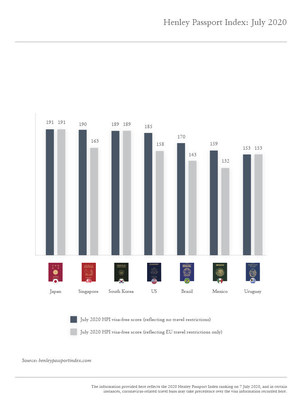
Experts suggest that the Covid-19 crisis is likely to make international mobility more restricted and unpredictable in the longer term. "Even as countries open their borders, it is expected that numerous governments will use epidemiological concerns as a justification for imposing new immigration restrictions and nationality-targeted travel bans that will mainly be aimed at citizens of developing countries," says Prof. Dr. Yossi Harpaz, Assistant Professor of Sociology at Tel Aviv University. Noting the recent decision by the EU with respect to the US and other countries, Harpaz says, "The passports of both developing and developed nations stand to decrease in value, at least temporarily. In such uncertain times, global demand for dual citizenship and investor visas is expected to increase."
Dr. Juerg Steffen, CEO of Henley & Partners, says for investors and their families, "having a second citizenship or an alternative residence is an even more precious asset than ever before, as concerns over access to first-rate healthcare, global mobility, and quality of life take on a new urgency."
Photo: https://mma.prnewswire.com/media/1200972/Henley_Passport_IndeInfographic.jpg
Media Contact
Paddy Blewer
Group PR Director
[email protected]

Ufficio Stampa
PR Newswire (Leggi tutti i comunicati)
209 - 215 Blackfriars Road
LONDON United Kingdom