IDTechEx Asks If Advanced Anode Technologies are the Way Forward for Better Li-ion Batteries
Comunicato Precedente

Comunicato Successivo


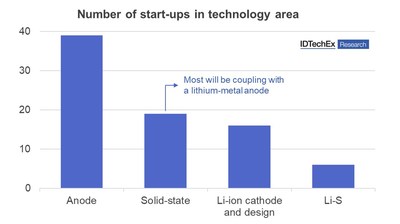
The issue with using silicon as an anode is longevity or lack thereof. The volume changes that it undergoes during cycling leads to the consumption of electrolyte and lithium and causes mechanical stresses that ultimately result in the loss of electrical and ionic conductivity. Incorporating porosity, electrolyte additives, and conductive and binding networks are just some of the solutions that are being developed. Silicon also has a reduced risk of dendrite formation, while the porosity and conductive additives that are generally needed further help with fast-charge capability and operation at low temperatures. Overall, silicon anodes represent a highly promising proposition and companies are now advertising cells with reasonable cycle lives, providing evidence that the key drawback of silicon is close to being overcome.
Lithium-metal anodes also hold great promise for improving energy density but again, they suffer from poor cycle life. They are also at higher risk of dendrite formation and short-circuits. Solid-state electrolytes are being widely developed as a solution but designs using a thin protective barrier and a stable liquid electrolyte are also being explored as a means to enable lithium-metal anodes. SES is a prominent example of a company using this type of approach. In fact, the use of a more conventional separator/electrolyte system may be beneficial to energy density and manufacturability, though the safety benefits of using a solid electrolyte may have to be diminished to some extent. With some of the performance and technical challenges with silicon and lithium-metal being solved, the key to their success is starting to shift toward how these solutions can be manufactured at scale and integrated into current battery manufacturing processes. With similar advantages and disadvantages, ultimately, the question will not be about the use of silicon or lithium, but the implementation of a given innovation or solution.
Beyond just energy density, fast charging is another key metric with the potential for grabbing headlines. Silicon anodes may be well suited to fast charging and claims around fast charging of Li-metal-based cells suggest improvements are being made here too, though performance needs to be verified in commercially relevant cell designs. But some applications may require both fast-charge capability and very long cycle lives beyond the 1000 cycles generally possible with Si or Li. More novel anode materials based on niobium and tungsten oxides are under development by Toshiba, Echion, and Nyobolt, with promises of 5-6 minute charging times, cycle lives in the 10's of thousands but with energy densities likely to sit below LFP.
While there is long-term upside for these materials, their comparatively low energy densities rule them out for BEVs and most consumer devices, though there are applications where this high-power, long cycle life capability could be highly valuable. As such graphite, followed by silicon and lithium-metal are set to be the key anode materials over the coming decade. IDTechEx forecast that demand for silicon anode material, by weight, will grow at a CAGR of 45% between 2022 to 2032. For more on technologies, players, and markets for advanced anode materials, please see the new IDTechEx report "Advanced Li-ion and Beyond Lithium Batteries 2022-2032: Technologies, Players, Trends, Markets". For more on IDTechEx's research on solid-state batteries, battery, or EV markets, please visit www.IDTechEx.com.
About IDTechEx
IDTechEx guides your strategic business decisions through its Research, Subscription and Consultancy products, helping you profit from emerging technologies. For more information, contact [email protected] or visit www.IDTechEx.com.
Images download:
https://www.dropbox.com/sh/z5it8v5jwiquf3q/AADk2dCYhfQSf054F3jH42goa?dl=0
Media Contact:
Natalie Moreton
Digital Marketing Manager
[email protected]
+44(0)1223 812300
Social Media Links:
Twitter: https://www.twitter.com/IDTechEx
LinkedIn: https://www.linkedin.com/company/idtechex/
Facebook: https://www.facebook.com/IDTechExResearch
Photo: https://mma.prnewswire.com/media/1744355/IDTechEAdvanced_Li_ion.jpg
Logo: https://mma.prnewswire.com/media/478371/IDTechELogo.jpg

Ufficio Stampa
PR Newswire (Leggi tutti i comunicati)
209 - 215 Blackfriars Road
LONDON United Kingdom