Polycarbonate Solar Vehicle Success, Reports IDTechEx
Comunicato Precedente

Comunicato Successivo


This year, Sono demonstrated a solar truck, again with the solar bodywork viable even on the sides and it landed a license deal to make the EasyMile robot shuttle solar-assisted. As private cars are banned from city centers, robot shuttles take over, so this is the future.
Charging is 10-40% faster when solar bodywork has already done some of it. This is deeply significant because it happens with existing chargers: it is not just a wait for expensive fast chargers and cars with thicker wiring. Lightyear and Sono also take a benefit in needing less battery. That helps to address the ongoing battery supply and safety issues, smaller batteries being safer.
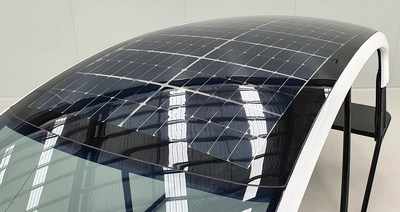
Teijin Limited and its joint development partner Applied Electric Vehicles (Applied EV) have developed another polycarbonate solar roof for future mobility applications. It uses Teijin's Panlite polycarbonate resin glazing for its surface. Teijin used its proprietary know-how in polycarbonate resin glazing and technologies to integrally mold the curved surface into an ideal vehicle shape, an extremely challenging process if using the glass alternative. Panlite achieves the strength and rigidity required for the vehicle.
Conventional polycarbonate resin offers excellent impact resistance, but it must be specially processed to realize the level of weather resistance needed for long-term outdoor use. Teijin's Panlite glazing, however, can easily be given a proprietary hard coating to achieve the 10-year weather durability required for automobiles.
Teijin and Applied EV solar roof was first shown this year on the Blanc Robot - a zero-emission robotic vehicle platform developed by Applied EV using materials and technical support from Teijin. In testing conducted by Applied EV in Australia, the solar cells mounted on the Panlite roof achieved output of about 330W, which is equivalent to a conventional solar panel housed under glass.
They find that, because this vehicle is light and very energy efficient, the benefits of solar charging the Blanc Robot are much greater than the results that can be achieved on a typical EV. Applied EV tests suggest that the solar array can contribute up to 30% of the vehicle's energy budget in ideal conditions and around 15-20% on a typical day. Under the right conditions, this could extend vehicle range for the Blanc Robot by between 30 and 55 kilometers, compared to the same vehicle without a Panlite roof.
Teijin and Applied EV continue to collaborate on the use of Teijin's various material technologies in the development of further EV components, including structural elements, glazing, and exterior body panels, with the intention of commencing high volume production in the latter half of 2022. These initiatives, together with ongoing efforts to further enhance the new solar roof, are expected to contribute to the ultimate goal of achieving Japan's Well-to-Wheel Zero Emission policy, which calls for a 90% reduction in 2010-level greenhouse gas emissions per passenger car by 2050.
Collaboration with Teijin is helping Applied EV to reduce the energy used per transport mile and also increase the proportion of energy that is sourced from renewables, which is good for business and good for the environment. They say it is now it is easy for them to roll out solar charging for a range of other vehicle types.
Meanwhile, Hyundai has announced that opaque and translucent solar bodywork will be widely deployed on future cars, the solar-assisted Sonata currently on sale being only a beginning. It has long collaborated with SABIC on polycarbonate vehicle glazing.
For more information on the IDTechEx report, please visit www.IDTechEx.com/Solar or for the full portfolio of Electric Vehicle and Energy research available from IDTechEx please visit www.IDTechEx.com/Research.
About IDTechEx
IDTechEx guides your strategic business decisions through its Research, Subscription and Consultancy products, helping you profit from emerging technologies. For more information, contact [email protected] or visit www.IDTechEx.com.
Images download:
https://www.dropbox.com/sh/ziw1f6j491uwixq/AACuZMoiMieIpmgO5S1InZkFa?dl=0
Media Contact:
Natalie Moreton
Digital Marketing Manager
[email protected]
+44(0)1223 812300
Social Media Links:
Twitter: https://www.twitter.com/IDTechEx
LinkedIn: https://www.linkedin.com/company/idtechex/
Facebook: https://www.facebook.com/IDTechExResearch
Photo: https://mma.prnewswire.com/media/1473116/IDTechESolar_Roof.jpg
Logo: https://mma.prnewswire.com/media/478371/IDTechELogo.jpg

Ufficio Stampa
PR Newswire (Leggi tutti i comunicati)
209 - 215 Blackfriars Road
LONDON United Kingdom