IDTechEx Commentary on Volkswagen's Long-term, High-Manganese Cathode Strategy
Comunicato Precedente

Comunicato Successivo


LMO (LiMn2O4) – firstly, commercially available high-manganese cathodes already exist in the form of the lithium-manganese oxide spinel, which was used for the 1st generation Nissan Leaf cars. However, it suffers from accelerated degradation at elevated temperatures, which leads to poor cycle life, hence the replacement of LMO with NMC in subsequent Nissan Leaf generations. With a theoretical capacity of only 148 mAh/g and an average discharge voltage of approximately 4.0-4.1 V, this cathode would lead to lower energy densities compared to cells using current state-of-the-art NMC or NCA layered oxides.
LMP (LiMnPO4) and LMFP (LiMnxFe1-xPO4) - LMP shares the same olivine crystal structure as LFP but operates at a more positive voltage, increasing energy density. Cycle life tends to be low, due to the high manganese content, while the material has poor electronic and ionic conductivity, meaning that reasonable capacities are generally only measured at low charge/discharge rates. The addition of Fe to form LMFP can improve conductivity and cycle life but lowers the average voltage. LMFP may bridge the gap between LFP and NMC/NCA but the reversible capacities of LMP and LMFP are too low to reach the cell-level energy densities of cells using NMC/NCA.
Li-Mn-rich (xLi2MnO3·(1 – x)LiMO3 where M = Ni, Mn, Co) – the lithium-manganese rich, layered-oxide cathode is one of only a few options, alongside conversion type cathodes, that offer a capacity improvement over current state-of-the-art NMC and NCA materials. However, stability and cycle life are poor and require considerable improvement before commercialization can be expected. BASF's high manganese cathode, NCM 217, may refer to a Li-Mn-rich type material.
This leaves LNMO as the most likely cathode VW were referring to. The high-voltage LNMO spinel (LiNi0.5Mn1.5O4) operates at a voltage of approximately 4.7 V vs. Li/Li+ and also holds potential as a high-power cathode due to its three-dimensional structure (improving Li diffusion pathways). However, its theoretical specific capacity is only 147 mAh/g, meaning it will not offer any advantage to specific energy or energy density over high-Ni NMC or NCA cathodes.
Furthermore, key issues with LNMO revolve around its low cycle life and poor stability, especially at elevated temperatures, whilst its high voltage also necessitates developments to electrolytes. As outlined by Volkswagen themselves, the use of high-manganese cathodes represents a long-term strategy.
Nevertheless, there is some commercial development of LNMO from the likes of Haldor Topsoe, NEI Corporation, and Targray. The potential for cost reduction that the material holds, without significantly reducing energy density, added to the possibility of eliminating cobalt consumption, suggests there is a future for this chemistry.
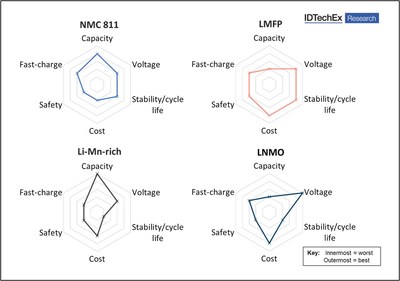
Given the trade-off between cost and different performance metrics from different Li-ion cathodes, a range of cathode materials will have to be employed by the Li-ion industry. Further detail and analysis of Li-ion technology trends, and their impact on battery material demand forecasts, can be explored in IDTechEx's reports "Li-ion Batteries 2020-2030" and "Materials for Electric Vehicle Battery Cells and Packs 2021-2031" or via an IDTechEx Market Intelligence Subscription. For more information on the subscription service, please contact [email protected]. For the full portfolio of Energy Storage research available from IDTechEx, please visit www.IDTechEx.com/Research/ES.
About IDTechEx
IDTechEx guides your strategic business decisions through its Research, Subscription and Consultancy products, helping you profit from emerging technologies. For more information, contact [email protected] or visit www.IDTechEx.com.
Images download:
https://www.dropbox.com/sh/u0q5nbtig03999t/AADDYOZIHzgsFXnxBrhWlWmga?dl=0
Media Contact:
Natalie Moreton
Digital Marketing Manager
[email protected]
+44(0)1223 812300
Social Media Links:
Twitter: https://www.twitter.com/IDTechEx
LinkedIn: https://www.linkedin.com/company/idtechex/
Facebook: https://www.facebook.com/IDTechExResearch
Photo: https://mma.prnewswire.com/media/1479640/IDTechEx.jpg
Logo: https://mma.prnewswire.com/media/478371/IDTechELogo.jpg

Ufficio Stampa
PR Newswire (Leggi tutti i comunicati)
209 - 215 Blackfriars Road
LONDON United Kingdom