AI for Sustainability: Materials Informatics is Driving Change, Finds IDTechEx
Comunicato Precedente

Comunicato Successivo


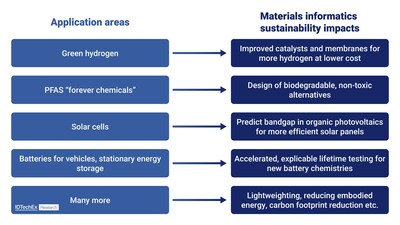
Players from across the AI industry are seeing materials informatics' ability to contribute in solving the climate crisis. Meta AI (of Facebook parent Meta) and Carnegie Mellon University's Open Catalyst Project aims to identify catalysts that aid the production of fuels using excess renewable energy. This project open-sources the discovery process, making the results of 260 million density functional theory (DFT) calculations publicly available for researchers to train their own surrogate models on.
Alongside the project's initiators, universities, including Munich Technical University and other AI giants, including Tencent AI, have published results calculated from the dataset. Applications of 'AI for good' in sustainability of this sort will likely become a major part of the ESG toolboxes of machine learning industry titans. These surrogate models could aid in decreasing the energy requirements to produce, for example, green hydrogen. IDTechEx covers the growing green hydrogen industry in its recent report, 'Green Hydrogen Production: Electrolyzer Markets 2023-2033'.
Solar photovoltaics (PV) are another fruitful area for materials informatics to make an impact. The IDTechEx report, 'Materials Informatics 2023-2033', discusses nine projects using machine learning to speed up the development of new PVs, including an MIT study using active learning to identify lead-free perovskites and work from Osaka University to produce correlations for bandgap and other properties from the structures of organic PVs. However, AI can facilitate yet more areas of PV development, including accelerated lifetime testing.
A March 2023 working paper from researchers at institutions including MIT and Microsoft details a model called DeepDeg, which its authors say speeds up degradation testing of organic solar cells by up to twenty times. Crucially, DeepDeg is designed to explain the degradation process of the candidate material, offering greater value to a selection process than simply predicting its lifespan. The involvement of Microsoft shows yet again the growing interest of the best-known AI players in materials informatics, particularly for sustainability projects.
Established firms are not alone in recognizing the potential of materials informatics to facilitate decarbonization. Early-stage firm ExoMatter is a spinout of the German Aerospace Center that emphasizes sustainability in its materials identification platform. It told IDTechEx that its platform not only can predict the carbon impact of the material candidates it identifies but had been used to identify 90 inorganic adsorbent candidates with better carbon retention properties for Dutch direct air capture startup Carbyon. Carbyon estimated this had saved it at least six months in the lab.
The materials industry itself is acting on the need for in-house data science expertise as its importance continues to grow, including in facilitating sustainable manufacturing. In February 2023, materials industry giant Toray Industries announced that it would be opening a new research facility for just this purpose. The plan is to bring together materials scientists, chemical engineers and digital transformation professionals to drive nanotechnology advances using materials informatics and computational chemistry. This highlights the increasingly cross-disciplinary nature of materials informatics, which has the potential to reduce the environmental impact of materials across their entire lifecycle, including their manufacturing processes and eventual disposal.
IDTechEx's report, 'Materials Informatics 2023-2033', is now in its third edition since IDTechEx began covering the field in 2020. Informed by first-hand interviews with the industry's major players, the report provides market forecasts, player profiles, investments, roadmaps, and comprehensive company lists, making this essential reading for anyone wanting to get ahead in this field.
To find out more, including downloadable sample pages, please visit www.IDTechEx.com/MIs.
Author: Sam Dale, Technology Analyst at IDTechEx
About IDTechEx
IDTechEx guides your strategic business decisions through its Research, Subscription and Consultancy products, helping you profit from emerging technologies. For more information, contact [email protected] or visit www.IDTechEx.com.
Images Download:
https://www.dropbox.com/scl/fo/yl9bowqlocoy8zgryqy2z/h?dl=0&rlkey=9tlglncpwar392cscb3395uw2
Media Contact:
Lucy Rogers
Sales and Marketing Administrator
[email protected]
+44(0)1223 812300
Social Media Links:
Twitter: www.twitter.com/IDTechEx
LinkedIn: www.linkedin.com/company/IDTechEx
Facebook: www.facebook.com/IDTechExResearch
Photo: https://mma.prnewswire.com/media/2060059/Material_informatics_sustainability.jpg
Logo: https://mma.prnewswire.com/media/478371/3998293/IDTechELogo.jpg
 View original content:https://www.prnewswire.co.uk/news-releases/ai-for-sustainability-materials-informatics-is-driving-change-finds-idtechex-301803868.html

Ufficio Stampa
PR Newswire (Leggi tutti i comunicati)
209 - 215 Blackfriars Road
LONDON United Kingdom